
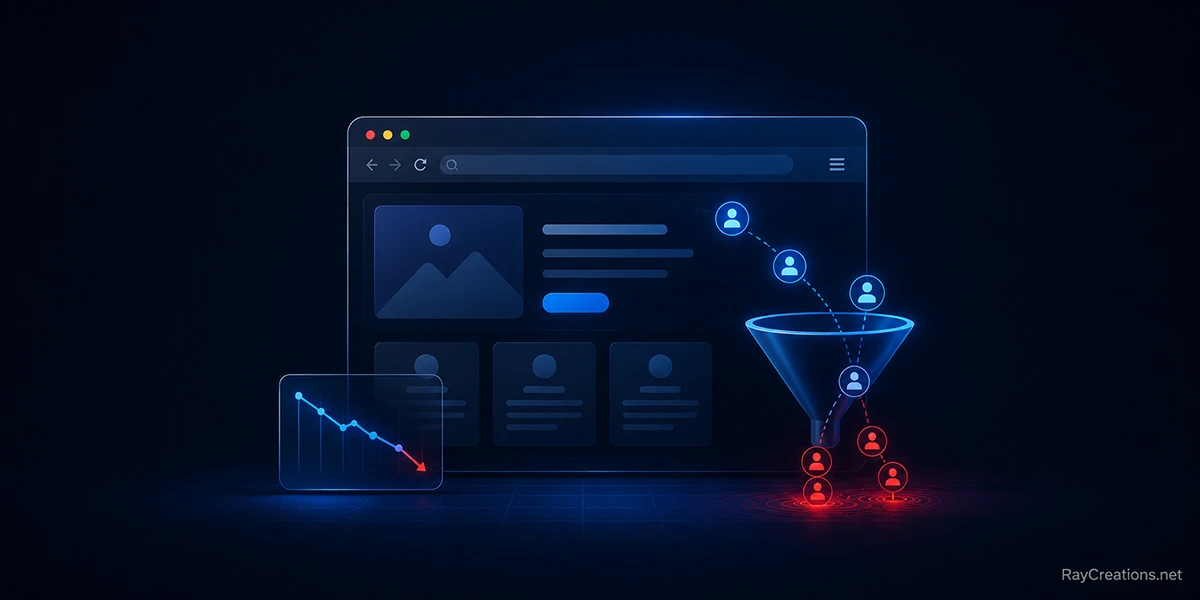
A website can look good, load properly and still fail to generate leads.
For a business owner, that can be incredibly frustrating. You have invested in a website, described your services, added a contact form and perhaps even spent time creating content. People may be visiting the site, yet the enquiries you expected simply are not arriving.
When this happens, the immediate reaction is often:
“There must be something wrong with my website.”
Sometimes there is.
But after working with business websites for many years, we have found that “my website is not generating leads” is not actually one problem. It can describe several completely different problems that require different solutions.
The website might not be receiving enough traffic.
It might be receiving the wrong traffic.
The right people may be visiting but failing to understand why they should choose the company.
Visitors may be interested but unable to find a clear next step.
Or the website may actually be receiving enquiries while a technical problem prevents those enquiries from reaching the business.
Before changing colours, rebuilding pages or launching another marketing campaign, you need to determine where the lead-generation process is breaking down.
That is what this guide will help you do.
First: Is It a Traffic Problem or a Conversion Problem?
This distinction is one of the most important things to establish.
Imagine a website gets 100 visitors per month and generates no enquiries.
Now imagine another gets 10,000 highly relevant visitors per month and still generates no enquiries.
Both businesses can say:
“My website isn’t getting leads.”
But they clearly do not have the same problem.
The first website may simply lack visibility.
The second almost certainly has a conversion, messaging, targeting or technical problem.
Before redesigning anything, look at four basic questions.
1. Is anyone finding the website?
Use tools such as Google Search Console and your analytics platform to understand how much search visibility and traffic the website actually receives.
If hardly anyone is visiting, redesigning the contact form is unlikely to solve the underlying problem.
2. Are the right people finding it?
Traffic itself is not the objective.
A business selling industrial equipment could attract thousands of visitors to an informational article while receiving very few enquiries if those visitors have no commercial reason to buy industrial equipment.
What matters is relevant traffic from people who could realistically become customers.
3. Are relevant visitors taking action?
If the website receives appropriate traffic but visitors rarely call, enquire, book or purchase, then you have a conversion problem.
That is where messaging, trust, page design, calls-to-action and usability become much more important.
4. Are enquiries actually reaching you?
This one is easily overlooked.
Forms can fail. Messages can land in spam. SMTP configuration can break. Tracking can be incorrectly configured. Phone numbers can be difficult to use on mobile.
Before concluding that your website produces no leads, make sure the lead-capture mechanisms themselves work.
Once you know which part of the process is failing, the problem becomes much easier to investigate.
1. Your Website Is Not Receiving Enough Qualified Traffic
A website cannot generate many leads if very few prospective customers ever see it.
This sounds obvious, but it is surprisingly common for businesses to expect a website to generate enquiries simply because it exists.
Publishing a website does not automatically create an audience.
Traffic may come from:
- organic search;
- Google Ads or other paid campaigns;
- social media;
- referrals;
- email;
- industry directories;
- offline marketing;
- existing customers;
- direct visits.
For many service businesses, search visibility becomes particularly valuable because prospective customers are actively looking for help.
If your important service pages barely appear in search results, the first priority may therefore be improving visibility rather than redesigning conversion elements.
This is where good website architecture, useful service pages, technical foundations and search engine optimization work together.
But remember that more traffic is not automatically better.
Which brings us to the next problem.
2. You Are Attracting Visitors Who Are Unlikely to Become Customers
A website can have impressive traffic numbers and still generate very little business.
We always prefer to look at traffic in context.
Suppose one website receives 20,000 visits and generates ten qualified enquiries.
Another receives 2,000 visits and generates thirty.
Which website is performing better?
The smaller audience may be dramatically more valuable.
This is particularly relevant to content marketing.
A blog article can attract people searching for information without necessarily attracting people who need the company’s services.
There is nothing inherently wrong with informational traffic. Good content can introduce people to your business, demonstrate expertise and build search visibility.
The problem occurs when the entire traffic strategy consists of people who have little reason to progress towards a commercial page.
Ask:
- What are visitors actually searching for?
- Which pages are receiving traffic?
- Are those pages related to your services?
- Are visitors in markets you serve?
- Does the content naturally lead them towards the next useful page?
Traffic should support the business objective rather than merely make an analytics graph look impressive.
3. Visitors Cannot Quickly Understand What You Do
Imagine arriving at a website for the first time.
You do not know the company.
You have not read its brochures.
You do not understand its internal terminology.
Within a few moments, you should be able to answer:
What does this company do?
Who does it help?
Why might I choose it?
If the homepage opens with phrases such as:
Innovative solutions for a changing world.
or:
Empowering businesses through excellence.
the wording might sound polished while communicating almost nothing.
Visitors should not have to decode your marketing language.
Clear usually beats clever.
A strong opening message often identifies:
- what you offer;
- who it is for;
- the main value or difference;
- what the visitor can do next.
This is one of the reasons homepage structure matters so much. Our guide to creating a high-converting home page goes much deeper into how the first page of a website should guide visitors.
4. Your Website Talks Too Much About You and Not Enough About the Customer
Businesses naturally want to talk about themselves.
Their history.
Their experience.
Their technology.
Their awards.
Their process.
Those things can absolutely help establish credibility.
But a prospective customer normally arrives with a different question:
“Can you solve my problem?”
If every page is written from the company’s perspective, visitors have to do the work of translating features into benefits themselves.
Compare:
We have 20 years of experience providing advanced logistics solutions.
with:
Reduce delays and gain better visibility across your supply chain with a team that has spent 20 years solving complex logistics problems.
The experience still matters.
But the second version connects that experience to something the customer cares about.
Good website copy should balance:
who you are + what you do + why that matters to the customer.
5. Your Service Pages Are Too Thin or Too Generic
A surprisingly common website structure is:
Home → Services → Contact
with every service summarized in a few sentences on one page.
That may be enough for a very small business with a simple offering.
For companies providing several distinct services, it often is not.
Someone looking for a particular solution usually wants more information before contacting a company.
A strong service page might explain:
- what the service is;
- who it is intended for;
- the problems it solves;
- what is included;
- how the process works;
- relevant examples;
- frequently asked questions;
- why the company is qualified to provide it;
- what the visitor should do next.
Dedicated service pages also give search engines much clearer information about what the business actually offers.
The objective is not to create pages simply to increase page count.
Every important commercial offering should have enough space to be understood properly.
6. There Is No Strong Reason to Trust You
A website asks visitors to make decisions without many of the signals available in a face-to-face interaction.
They cannot walk into your office.
They may never have heard your company name.
They cannot immediately judge whether you are knowledgeable, established or dependable.
Your website therefore has to reduce that uncertainty.
Useful trust signals can include:
- real client testimonials;
- Google reviews;
- case studies;
- project examples;
- recognizable customers where permission exists;
- team information;
- years of experience;
- certifications;
- industry memberships;
- awards;
- clear contact details;
- a genuine physical business address where relevant;
- transparent policies;
- useful original content.
The right trust signals vary by industry.
A law firm’s credibility may depend heavily on attorney profiles and legal experience.
An industrial company’s website may need projects, certifications and technical capabilities.
A web design company should be able to show actual websites it has designed.
Generic claims such as “we are the best” carry much less weight than evidence that allows visitors to reach that conclusion themselves.
7. Your Calls-to-Action Are Weak, Hidden or Premature
Once visitors understand what you offer, what should they do?
Many websites never answer that question clearly.
Others use the same call-to-action everywhere:
CONTACT US
That is not necessarily wrong, but it may not always fit what the visitor is ready to do.
Different visitors have different levels of intent.
Someone reading a detailed service page might be ready to request a quotation.
Someone reading an educational article may simply want to explore a related service.
Someone evaluating several providers may prefer to look at case studies first.
Useful calls-to-action could include:
- Request a Quote
- Book a Consultation
- Discuss Your Project
- View Our Work
- See How the Service Works
- Request a Website Review
- Call Us
- Get Pricing
- Read the Related Guide
Calls-to-action should be clear, relevant and visible without becoming aggressive.
A website should guide people.
It should not constantly shout at them.
8. Your Contact Form Creates Too Much Friction
Every extra field in a form asks the visitor to do more work.
Sometimes that additional information is necessary.
A complex B2B project may genuinely require more detail before a useful conversation can begin.
But many businesses ask for information simply because the form allows them to.
Do you really need a visitor’s:
- full postal address;
- company registration number;
- exact annual turnover;
- ten separate project fields;
before you have even spoken to them?
Probably not.
Ask only for information that is useful at that stage of the relationship.
It is also worth considering alternatives.
Some visitors prefer email.
Others prefer telephone.
Some want to book a meeting.
Different options can reduce friction, provided the page does not become confusing.
And test the form yourself regularly.
A perfectly designed form generates zero leads if its emails are not being delivered.
9. Your Website Is Slow, Awkward or Difficult to Use on Mobile
Visitors do not distinguish between a design problem and a technical problem.
They simply experience frustration.
A website may lose opportunities because:
- pages load slowly;
- buttons are difficult to tap;
- text is too small;
- navigation is confusing;
- pop-ups cover the screen;
- forms are awkward on a phone;
- layouts break at certain widths;
- important information appears far down the page;
- scripts fail;
- links do not work.
Mobile experience is particularly important because a responsive website should do much more than technically fit onto a smaller screen.
Information needs to remain understandable and actions need to remain convenient.
Our responsive web design page explains the broader approach, but the basic test is simple:
Can a real customer comfortably complete the important tasks on your website from a phone?
If not, that friction can cost leads.
10. Your Homepage Is Trying to Do Too Much
Some homepages try to explain the entire company at once.
Every service.
Every award.
Every blog post.
Every team member.
Every feature.
Every piece of company history.
The result is often a very long page with no obvious priority.
The homepage does not need to contain everything.
It needs to help visitors understand the business and move towards the information most relevant to them.
A useful homepage usually establishes:
- what the business does;
- who it helps;
- why it is credible;
- its most important services;
- evidence or proof;
- clear paths deeper into the site;
- an appropriate next action.
This is exactly why we treat the homepage as an important part of the conversion journey rather than merely a visual introduction.
11. Your Content Generates Readers but Does Not Create a Journey
This is particularly relevant if you publish articles regularly.
A blog post may answer a question extremely well and still contribute very little to lead generation if the reader reaches the end and has nowhere logical to go.
Suppose someone finds an article about redesigning an outdated website.
The next useful step might be:
- another article explaining redesign warning signs;
- a guide about protecting SEO during redesign;
- examples of redesign projects;
- the website design service;
- a site-review request.
That is a natural journey.
It is very different from inserting an unrelated sales banner halfway through an article.
Internal linking helps visitors discover that next step while also helping search engines understand relationships between your pages.
This is one reason we have been increasingly deliberate about planning content as interconnected topic clusters rather than isolated blog posts.
12. Your Offer Is Not Strong or Differentiated Enough
Sometimes the website is not the real problem.
The offer is.
If five competing companies appear to provide essentially the same thing, visitors need some basis for choosing.
Price can be one differentiator, but it certainly is not the only one.
A business might stand out through:
- specialization;
- deeper expertise;
- faster delivery;
- better support;
- a distinctive process;
- stronger guarantees;
- industry experience;
- convenience;
- quality;
- transparency;
- long-term service.
Your website needs to communicate the differences that genuinely matter.
Do not invent artificial uniqueness.
If your real advantage is that clients get direct access to experienced specialists rather than being passed through multiple account managers, say that.
If you specialize in one industry, demonstrate that knowledge.
If your support continues long after launch, explain how.
Differentiation becomes convincing when it is specific and provable.
13. You Are Asking for the Sale Too Early
Not every website visitor is ready to buy.
Some are researching.
Some are comparing providers.
Some have only just recognized that they have a problem.
If the website offers only two choices—
Buy now or leave—
many people will leave.
For higher-value services particularly, buyers often need more reassurance.
Useful intermediate content might include:
- case studies;
- detailed service information;
- pricing guidance;
- FAQs;
- comparison pages;
- process explanations;
- educational resources;
- project examples.
The website should support different stages of decision-making.
Conversion does not always happen during the first visit.
14. Technical Problems Are Quietly Losing Leads
Not every conversion problem is visible.
This is one area we would always check before making major strategic changes.
Make sure:
- forms actually submit;
- form notifications reach the correct inbox;
- confirmation messages work;
- important email is not consistently going to spam;
- telephone links work on mobile;
- booking tools function correctly;
- live chat works if you use it;
- SSL is valid;
- important pages return the correct status;
- analytics and conversion events are recording properly.
Website owners sometimes judge lead generation solely by what appears in an email inbox.
That is risky.
Where possible, submissions should also be stored or logged safely so that a temporary email-delivery problem does not silently erase a business opportunity.
Ongoing website maintenance is not only about installing updates. It also means making sure the systems the business depends on continue working as intended.
15. You Are Not Measuring the Right Things
If your only website metric is total traffic, diagnosing a lead problem becomes difficult.
You need enough information to understand the journey.
Depending on the business, useful measurements may include:
- organic search impressions;
- clicks;
- landing pages;
- traffic sources;
- important page visits;
- form submissions;
- telephone clicks;
- bookings;
- purchases;
- CTA interactions.
The purpose is not to track everything simply because modern analytics software allows it.
Track what helps answer useful questions.
For example:
Are people finding us?
Search impressions and clicks may help answer that.
Are visitors reaching our commercial pages?
Landing-page and navigation data can help.
Are people attempting to enquire?
Conversion events can help.
Did the enquiry actually reach us?
That may require checking the form system itself.
Measurement should reduce uncertainty.
16. Your Website May Simply No Longer Represent the Business
Businesses evolve faster than websites sometimes do.
Services change.
Target customers change.
Teams grow.
Brands mature.
What was accurate five years ago may no longer represent the company today.
An outdated website can create several lead-generation problems simultaneously:
- old messaging;
- missing services;
- weak mobile layouts;
- dated visuals;
- poor navigation;
- obsolete technology;
- weak content;
- no meaningful conversion path.
That does not mean every old website needs to be replaced.
Sometimes improvements to messaging, structure and individual pages are enough.
But if the problems are fundamental, a redesign may make sense.
Our guide to signs that it may be time to redesign your website can help you make that distinction.
And if a redesign does happen, existing search visibility should be protected carefully. Changing URLs or removing content without a migration plan can create a second problem while trying to solve the first, which is why we also recommend considering SEO during a website redesign.
What If Your WordPress Site Is Not Generating Leads?
This deserves a short section of its own because businesses sometimes assume the website platform must be the problem.
WordPress itself does not generate leads.
Neither does another CMS simply by being another CMS.
WordPress provides the underlying system. Lead generation depends much more heavily on:
- visibility;
- audience targeting;
- messaging;
- design;
- content;
- trust;
- user experience;
- calls-to-action;
- forms;
- performance;
- measurement.
A poorly planned WordPress site can perform badly.
A well-planned WordPress site can become a very effective business platform.
Changing technology makes sense when the existing platform genuinely limits the business. It should not be the first response to a marketing or conversion problem that exists somewhere else.
If you are planning a new site or considering a more fundamental rethink, our website planning guide covers the decisions worth making before design and development begin.
A Practical Website Lead-Generation Checklist
If your website is not generating leads, work through these questions in order.
Traffic
- Is the website receiving meaningful traffic?
- Are important pages appearing in search?
- Are visitors coming from markets you actually serve?
- Are the search terms relevant to your services?
Messaging
- Can visitors immediately understand what you do?
- Is it clear who your services are for?
- Does the website explain why your offering matters?
- Are important services described properly?
Trust
- Are there testimonials or reviews?
- Are there genuine projects, results or case studies?
- Is your company information easy to verify?
- Does the website look actively maintained?
Conversion
- Does every important page have a sensible next step?
- Are calls-to-action visible and specific?
- Is the enquiry form easy to complete?
- Are different contact methods available where appropriate?
Technical
- Do forms work?
- Are enquiry emails being delivered?
- Does the site work properly on mobile?
- Does it load reasonably quickly?
- Are important links and interactive features functioning?
Measurement
- Do you know where traffic comes from?
- Do you know which pages visitors enter through?
- Are meaningful conversions tracked?
- Can you tell where potential customers are leaving the journey?
If you cannot answer several of these questions, that is where the investigation should begin.
Do Not Redesign Everything Until You Know What Is Broken
This is probably the most important takeaway.
A website that is not generating leads does not automatically need a complete redesign.
Sometimes the problem is search visibility.
Sometimes the offer is unclear.
Sometimes a key service has no proper landing page.
Sometimes the homepage needs a stronger structure.
Sometimes the call-to-action is buried.
Sometimes a form is simply not delivering email.
And sometimes, yes, the website has accumulated enough structural, technical and design problems that rebuilding it is the sensible solution.
The important thing is to diagnose before prescribing.
Changing everything at once makes it difficult to know what actually solved the problem.
Final Thoughts
A business website should do more than exist.
It should help prospective customers understand what you offer, decide whether they trust you, find the information they need and take an appropriate next step.
When that does not happen, avoid assuming there is one universal reason.
Ask:
Are enough of the right people finding the website?
Does the website communicate clearly once they arrive?
Does it give them a reason to trust the business?
Is the next step obvious and easy?
Are the technical systems actually capturing the enquiry?
Those questions separate a vague complaint—“our website gets no leads”—into problems that can actually be investigated and fixed.
At Ray Creations, this is also how we prefer to approach an underperforming website. Rather than recommending a redesign simply because a website is old or because a new design would look better, it makes more sense to first understand what is preventing the existing website from doing its job.
If you are unsure where the problem lies, you can request a website review and we can look at the structure, messaging, usability and technical foundations before deciding what deserves to change.
If the website ultimately does need a more substantial rebuild, our Custom Website Design service is built around the same principle: plan around the audience and business objective first, then design the website around those decisions.